
Security & Surveillance
We build complete surveillance systems with an Operations Control Center at the core.
TAP builds complete surveillance systems with an operations control center at the core, so incidents are answered while they matter.
An Operations Control Center is one room where every camera in your organization converges. Feeds from gates, perimeters, roads, halls, and remote sites arrive over a dedicated network, appear on a video wall, and are watched by trained operators around the clock. Every incident is verified on screen, logged, and answered under a written procedure.
Operations Control Center
From Recording to Monitoring
An operations control center is one room where every camera converges. Feeds from gates, perimeters, roads, halls and remote sites arrive over a dedicated network, appear on a video wall and are watched by trained operators.
Tells You What Happened
- Footage reviewed after the event
- Cameras checked when someone remembers
- Each site managed separately
- Evidence searched by hand
Responds While It Matters
- Events seen live and verified on screen
- Analytics flag events for the operator
- Every site watched from one room
- Responders directed to the exact location
Every Camera Answers to One Room
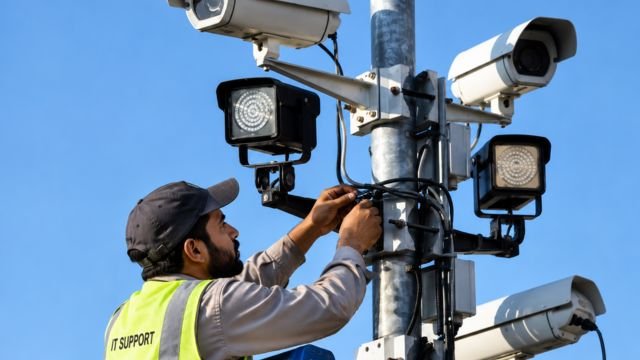
TAP delivers the OCC as one project. We survey your sites, identify the points a camera must cover, and design the full chain: the cameras, the fiber and wireless links that carry the video, the recording servers that store it, and the control room where it all lands. Nothing is left for another contractor to finish.
The control room itself is engineered, not furnished. We build the video wall, the operator consoles, the lighting, and the power backup around how operators actually work a shift. Camera layouts, screen assignments, and alarm handling follow written procedures that we prepare with your security management, so every operator responds to an incident the same way.
What We Deliver
From the Camera Pole to the Control Room Chair
Workstreams, delivered under one contract, make up a complete surveillance system.
01Camera NetworksCoverage by site survey
Fixed, PTZ, panoramic, thermal and number-plate recognition cameras, positioned by site survey to cover every risk point without gaps.
- Coverage design
- Day and night imaging
- Vandal-resistant housings
- Poles and mounts
02Transmission NetworkDedicated and separated
Dedicated fiber and wireless links carry every feed to the control room on a network separated from ordinary office traffic.
- Fiber backbone
- Point-to-point wireless
- PoE switching
- Network segmentation
03Recording & Video ManagementEvery stream, retrievable in seconds
Video management software and redundant recording servers store every stream and retrieve any minute of footage in seconds.
- Open-platform VMS
- Redundant recording
- Role-based access
- Evidence export
04Video Wall & ConsolesThe physical control room
Video wall displays, operator consoles, control room furniture, acoustics, lighting and backup power, designed around a full shift.
- Video wall
- Operator consoles
- Ergonomic layout
- UPS and backup power
05Video AnalyticsEvents flagged automatically
Motion, intrusion, line crossing and number-plate analytics that flag events for the operator instead of waiting to be noticed.
- Intrusion detection
- Line crossing
- ANPR
- Forensic search
06Operators & SOPsEvery alarm handled the same way
Operator training, shift structures and written response procedures, so every alarm is verified, logged and acted on consistently.
- Standard operating procedures
- Shift design
- Operator training
- Incident logs
Camera Range
The Right Camera for Every Point
Each camera is selected for the job its location demands, specified against the site survey rather than a standard drawing.
Fixed Cameras
- Use
- Gates, entrances, corridors and fixed scenes
- Strength
- Continuous, detailed view of one area
PTZ Cameras
- Use
- Open areas, junctions and perimeters
- Strength
- Operator-controlled pan, tilt and zoom
Panoramic Cameras
- Use
- Squares, halls and large open spaces
- Strength
- Wide situational view from one point
Thermal Cameras
- Use
- Perimeters, darkness and poor weather
- Strength
- Detection without visible light
ANPR Cameras
- Use
- Entry points and key roads
- Strength
- Automatic number-plate reading and logging
Mobile & Vehicle Cameras
- Use
- Patrol vehicles and temporary sites
- Strength
- Coverage that moves with operations
Video Analytics
Events Flagged for the Operator
Analytics watch every feed continuously and raise alerts, so operators focus on the screens that matter.
Intrusion Detection
People or vehicles in restricted zones
Line Crossing
Movement across a defined boundary
Loitering
Presence beyond a set time
Crowd Monitoring
Density and unusual gatherings
Abandoned Objects
Items left in public areas
Number-Plate Recognition
Vehicles read and logged
Object Classification
People and vehicles distinguished
Forensic Search
Footage searched by event and attribute
Video wall layout
Screens assigned by area and priority
Operator consoles
Ergonomic positions for long shifts
Supervisor position
Oversight of every operator
Lighting and acoustics
Glare-free, low-fatigue environment
Backup power
UPS and generator support
Equipment room
Servers and network on protected power
Engineered Around a Full Shift
A control room is a working environment for operators who watch screens for hours at a time. TAP designs every element around sightlines, workload and continuity, so attention stays on the incidents that matter.
Technologies
Leading Manufacturers, One Integrated System
TAP works with established manufacturers across cameras, video management and display, and integrates them through open standards such as ONVIF.
Cameras
- Axis
- Bosch
- Hanwha
- Hikvision
- Dahua
Video Management
- Milestone
- Genetec
Video Walls & Display
- Barco
The TAP Way
How We Deliver, and the Impact on Your Operations
Each part of our method produces a measurable improvement in security operations.
We survey every site and design camera coverage around actual risk points, not a standard drawing.
Incidents Get Answered
Operators verify events live and dispatch a response while there is still something to prevent.
We build the complete chain under one contract: cameras, network, recording, video wall and control room fit-out.
Crime Is Deterred
Visible, monitored coverage discourages theft and intrusion before it starts.
We write the response procedures with your security management and train the operators who will run the room.
Evidence Holds Up
Time-stamped, retrievable recordings support investigations, insurance claims and legal proceedings.
We maintain the system after handover, replacing failed cameras and links before they become blind spots.
One System, One Owner
A single TAP contract covers the whole chain, so no fault falls between two vendors.